
Decimal and Fraction Operations Practice
Loading the math board and drawing, please wait…
In collections
Bruchzahlen: Erweitern und Kürzen
Wiederholung II: Erweitern & Kürzen, Darstellungsarten
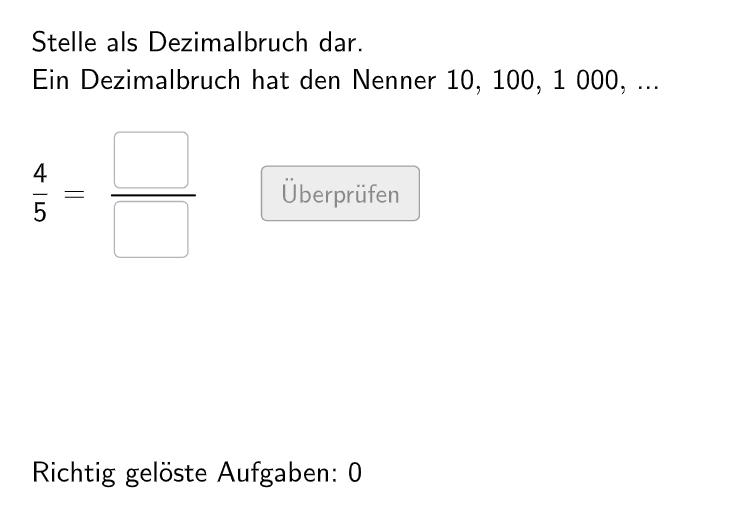
This example provides interactive exercises to help students understand the conversion between decimals and fractions. Key mathematical concepts include decimals, fractions, and their basic operations. Using GeoGebra commands such as Shuffle and RandomElement, students can practice with randomly generated questions, enhancing their understanding of decimals and fractions. Suitable for students in
GeoGebra Commands & Parameters
Shuffle({2, 5}) → randomNosForY_1, {5, 2}RandomElement(randomNosForY_1) → numY_1Shuffle(Sequence[Random[1, numY_1], i, 1, 100]) → randomNosForX_1, {3, 2, 1, 5, 4, 5, 3, 3, 5, 5, 1, 4, 1, 1, 5, 1, 2, 1, 1, 1, 2, 1, 5, 1, 3, 4, 4, 1, 1, 1, 3, 4, 1, 5, 2, 3, 2, 5, 4, 5, 1, 2, 2, 1, 5, 2, 2, 1, 3, 1, 5, 2, 1, 5, 2, 5, 2, 4, 5, 3, 1, 4, 4, 2, 4, 3, 4, 1, 5, 4, 1, 2, 4, 2, 3, 2, 1, 2, 5, 1, 4, 2, 1, 5, 2, 5, 2, 1, 1, 1, 4, 3, 4, 1, 5, 3, 5, 4, 2, 3}Element(randomNosForX_1, Mod[questionCount, 100] + 1) → numX_1If(numX_1 ≟ numY_1, numX_1 - 1, numX_1) → sol_1Shuffle({2, 4, 5, 25, 50}) → randomNosForY_2, {50, 4, 5, 25, 2}RandomElement(randomNosForY_2) → numY_2Shuffle(Sequence[Random[1, numY_2], i, 1, 100]) → randomNosForX_2, {1, 2, 1, 1, 1, 2, 1, 1, 1, 1, 1, 2, 1, 1, 2, 2, 1, 1, 2, 1, 2, 2, 2, 1, 2, 2, 2, 2, 1, 1, 2, 2, 2, 2, 1, 2, 2, 2, 1, 1, 1, 1, 1, 1, 2, 2, 2, 2, 2, 2, 2, 1, 2, 2, 1, 2, 1, 1, 2, 2, 1, 1, 2, 2, 1, 2, 1, 2, 2, 2, 2, 2, 2, 1, 1, 2, 1, 1, 1, 2, 2, 1, 2, 2, 2, 2, 2, 2, 2, 2, 1, 1, 2, 2, 2, 2, 1, 1, 1, 1}Element(randomNosForX_2, Mod[questionCount, 100] + 1) → numX_2If(numX_2 ≟ numY_2, numX_2 - 1, numX_2) → sol_2Shuffle({2, 4, 5, 8, 20, 25, 40, 50, 125, 200, 250, 500}) → randomNosForY_3, {200, 500, 20, 125, 40, 250, 8, 2, 50, 5, 4, 25}RandomElement(randomNosForY_3) → numY_3Shuffle(Sequence[Random[1, numY_3], i, 1, 100]) → randomNosForX_3, {3, 4, 1, 2, 2, 5, 1, 3, 4, 1, 1, 5, 5, 1, 1, 1, 1, 2, 5, 1, 4, 4, 2, 3, 3, 1, 4, 2, 5, 3, 4, 5, 3, 3, 2, 3, 4, 4, 1, 3, 1, 4, 3, 1, 2, 2, 1, 4, 4, 3, 5, 2, 5, 2, 4, 5, 5, 1, 3, 5, 1, 2, 1, 2, 4, 4, 5, 1, 2, 4, 5, 3, 5, 4, 1, 5, 5, 5, 5, 2, 4, 4, 5, 4, 1, 4, 2, 3, 5, 1, 1, 3, 1, 2, 2, 5, 2, 2, 4, 1}Element(randomNosForX_3, Mod[questionCount, 100] + 1) → numX_3If(numX_3 ≟ numY_3, numX_3 - 1, numX_3) → sol_3Join({{4}, Shuffle[Sequence[Random[1, 3], i, 1, 100]]}) → randomNosForLayElement(randomNosForLay, Mod[questionCount, 100]) → layIf(lay ≟ 4, 10, If[lay ≟ 1, 10, If[lay ≟ 2, 100, 1000]]) → solYIf(lay ≟ 4, 8, If[lay ≟ 1, (sol_1 * 10 / numY_1), If[lay ≟ 2, (sol_2 * 100 / numY_2), (sol_3 * 1000 / numY_3)]]) → solXIf(numY(lay) > 100, aInput ≟ 1000 ∨ aInput ≟ 100 ∨ aInput ≟ 10, If[numY(lay) > 10, aInput ≟ 100 ∨ aInput ≟ 1000 ∨ aInput ≟ 10, aInput ≟ 10 ∨ aInput ≟ 100 ∨ aInput ≟ 1000]) → correct2Corner(text3, 3) → C_TextTextfield(aInput) → InputBox1Textfield(bInput) → InputBox2Polygon(PtopLeftCornerFeedback, PtopRightCornerFeedback, PbottomRightCornerFeedback, PbottomLeftCornerFeedback) → rectangleCorrect, ptopleftcornerfeedback, ptoprightcornerfeedback, pbottomrightcornerfeedback, pbottomleftcornerfeedbackSegment(A, B) → fPolygon(PtopLeftCornerFeedback_{1}, PtopRightCornerFeedback_{1}, PbottomRightCornerFeedback_{1}, PbottomLeftCornerFeedback_{1}) → rectangleCorrect_{1}, ptopleftcornerfeedback_{1}, ptoprightcornerfeedback_{1}, pbottomrightcornerfeedback_{1}, pbottomleftcornerfeedback_{1}Textfield(cInput) → InputBox3Polygon(PtopLeftCornerFeedback_{2}, PtopRightCornerFeedback_{2}, PbottomRightCornerFeedback_{2}, PbottomLeftCornerFeedback_{2}) → rectangleCorrect_{2}, ptopleftcornerfeedback_{2}, ptoprightcornerfeedback_{2}, pbottomrightcornerfeedback_{2}, pbottomleftcornerfeedback_{2}CircleArc(C, D, E) → cCircleArc(F, G, H) → dPoint(c) → IVector(I, J) → uPoint(d) → KVector(K, L) → vIf(Mod[10, numY(lay)] ≟ 0, hintZehn(1), If[Mod[100, numY(lay)] ≟ 0, hintZehn(2), hintZehn(3)]) → chosenHintZahl