
Constructing a Parallelogram with an Area of 24 Square Centimeters
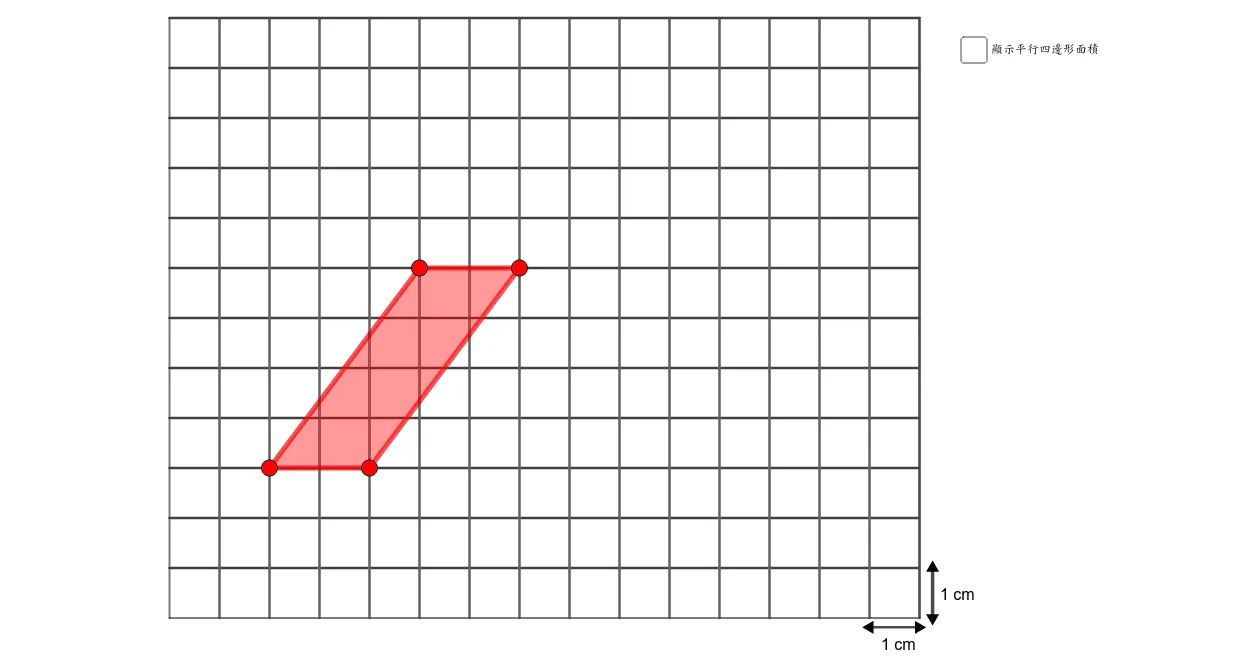
This interactive GeoGebra applet demonstrates how to construct and explore a parallelogram constrained to a fixed area of exactly 24 square centimeters. By utilizing fundamental geometric tools such as points, segments, and polygons, alongside dynamic distance and area calculations, the application provides a hands-on environment for investigating plane geometry. The core mathematical concept highlighted in this construction is the area formula for a parallelogram, where the area is the product of the base and the perpendicular height. Because the area is locked at a constant value, the applet dynamically illustrates the inverse proportional relationship between the length of the base and the corresponding height.
Users can interact with the model by dragging the defining vertices of the parallelogram. As a student manipulates the base to make it longer or shorter, the applet automatically recalculates and adjusts the height to ensure the total area remains precisely 24 square centimeters. Real-time numerical readouts display the current measurements of the base, the height, and the resulting area, allowing learners to verify the mathematical relationship instantaneously. Furthermore, the construction visually reinforces the concept of perpendicular height, distinguishing it from the slant length of the adjacent sides, which is a common misconception among students learning quadrilateral properties.
This geometric construction is highly beneficial for students as it transforms a static algebraic formula into a dynamic, visual experience. It helps learners intuitively grasp why an infinite number of differently shaped parallelograms can share the exact same area. By observing the continuous trade-off between base and height, students build a deeper conceptual understanding of inverse variation in a geometric context. Educators can use this applet to prompt inquiry-based learning, asking students to predict how the shape will change if the base is doubled, or to find the specific dimensions that would turn the parallelogram into a rectangle while maintaining the 24 square centimeter constraint. Ultimately, this tool bridges the gap between abstract algebraic equations and concrete geometric realities, making it an invaluable resource for middle and high school geometry curricula.
In collections
Area in Geometry
Loading the math board and drawing, please wait…