
Conic Sections: Plane-Cone Intersection with Dandelin Spheres
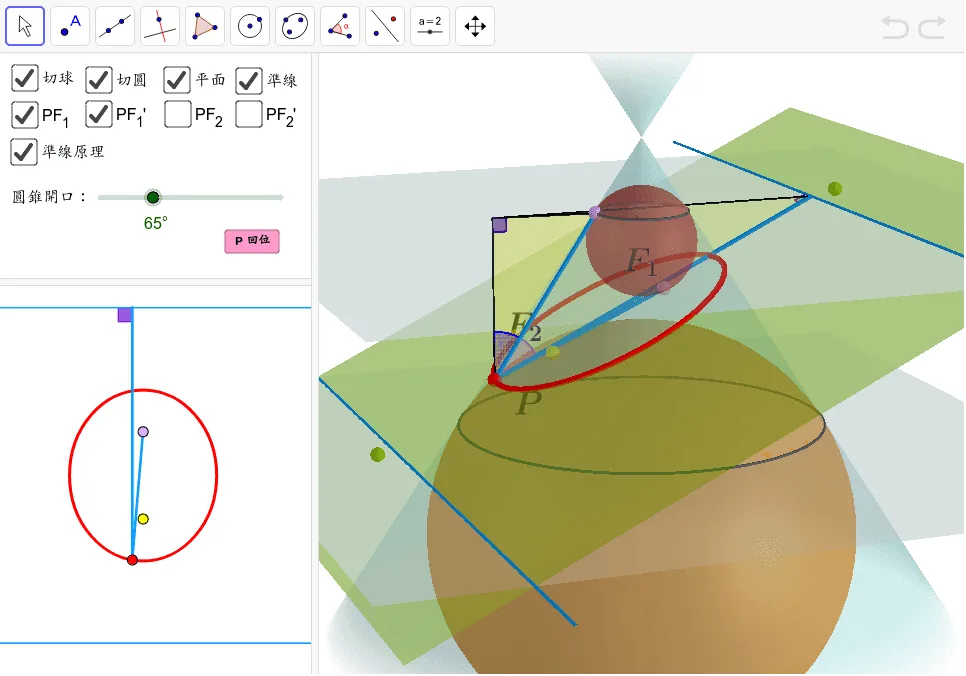
This example demonstrates the geometric generation of conic sections through the intersection of a plane with an infinite cone. It illustrates how ellipses, parabolas, and hyperbolas are formed by varying the angle of the cutting plane relative to the cone's axis. Dandelin spheres are used to visually prove the focal properties of conic sections, revealing their intrinsic geometric nature. Includes auxiliary constructions such as angle bisectors, intersection points, and distance measurements that support the rigorous geometric proof. The applet allows students to dynamically adjust the cone angle, the cutting plane position, and the sphere size, observing in real time how the conic section changes as the plane transitions from a steep angle (ellipse) to parallel to a generator (parabola) and then to a shallower angle (hyperbola). The Dandelin spheres, inscribed within the cone and tangent to both the cone surface and the cutting plane, provide an elegant visualization of why every conic section possesses one or two focal points. For ellipses and hyperbolas, two Dandelin spheres yield two foci whose sum or difference of distances to any point on the curve remains constant. For parabolas, a single Dandelin sphere yields one focus and the directrix line. This interactive demonstration is ideal for high school and undergraduate courses in analytic geometry and solid geometry, helping students move beyond abstract algebraic definitions to a deep geometric intuition about conic sections and their defining properties.
In collections
Conic Sections
Loading the math board and drawing, please wait…