
Comparing Rational Numbers - Klecksaufgaben
Loading the math board and drawing, please wait…
In collections
Ordnen und Vergleichen von rationalen Zahlen
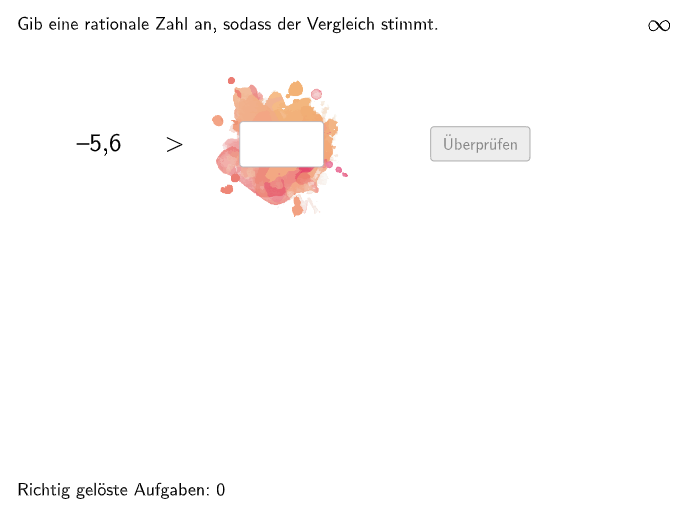
This example demonstrates how to compare rational numbers. Students can adjust the numbers to compare the size of rational numbers. The core math concepts involved are the comparison of rational numbers and the representation of rational numbers on the coordinate plane. The construction points include using GeoGebra's Join, Zip, Transpose commands, and using Sequence and If commands to control the
GeoGebra Commands & Parameters
Join(Sequence[Shuffle[{1, 2}], m, 1, 60]) → listExTypeZip(If[m ≟ 1, 0, RandomElement[{1, 1, 0}]], m, listExType) → listExType2MinusJoin(Sequence[Shuffle[{-1, -1, 1}], m, 1, 40]) → listVZXJoin(Sequence[Shuffle[{-1, -1, 1}], m, 1, 40]) → listVZYJoin(Sequence[Shuffle[{1, 2, 3, 4, 4}], m, 1, 30]) → listNumTypeYJoin(Sequence[Shuffle[{1, 2, 3, 4, 4}], m, 1, 30]) → listNumTypeXTranspose({{A1, B1}, {A2, B2}, {A3, B3}, {A4, B4}, {A5, B5}, {A6, B6}, {A7, B7}, {A8, B8}, {A9, B9}, {A10, B10}, {A11, B11}, {A12, B12}, {A13, B13}, {A14, B14}, {A15, B15}, {A16, B16}, {A17, B17}, {A18, B18}, {A19, B19}, {A20, B20}, {A21, B21}, {A22, B22}, {A23, B23}, {A24, B24}, {A25, B25}, {A26, B26}, {A27, B27}, {A28, B28}, {A29, B29}, {A30, B30}, {A31, B31}, {A32, B32}, {A33, B33}, {A34, B34}, {A35, B35}, {A36, B36}, {A37, B37}, {A38, B38}, {A39, B39}, {A40, B40}, {A41, B41}, {A42, B42}, {A43, B43}, {A44, B44}, {A45, B45}, {A46, B46}, {A47, B47}, {A48, B48}, {A49, B49}, {A50, B50}, {A51, B51}, {A52, B52}, {A53, B53}, {A54, B54}, {A55, B55}, {A56, B56}, {A57, B57}, {A58, B58}, {A59, B59}, {A60, B60}, {A61, B61}, {A62, B62}, {A63, B63}, {A64, B64}, {A65, B65}, {A66, B66}, {A67, B67}, {A68, B68}, {A69, B69}, {A70, B70}}) → listFractionsAllSequence(Random[2, Length[listFractionsAll(1)]], m, 1, 120) → randomNosForXBruch, {33, 30, 38, 41, 69, 27, 47, 24, 7, 67, 58, 46, 19, 46, 44, 57, 45, 62, 29, 60, 48, 57, 56, 50, 68, 24, 43, 68, 55, 15, 23, 33, 16, 20, 40, 57, 19, 66, 41, 30, 20, 39, 20, 37, 40, 48, 19, 65, 42, 12, 17, 68, 15, 37, 69, 64, 31, 11, 23, 36, 40, 44, 31, 24, 32, 16, 16, 43, 58, 41, 48, 55, 44, 55, 66, 21, 10, 25, 33, 26, 60, 54, 36, 27, 70, 49, 62, 45, 33, 51, 33, 60, 56, 37, 50, 64, 18, 52, 10, 49, 55, 58, 48, 3, 10, 41, 33, 34, 15, 49, 62, 68, 47, 24, 59, 42, 6, 16, 49, 34}Zip(Random[1, m - 1], m, randomNosForXBruch) → randomNosForYBruchSequence(Random[2, Length[listDecimalNums1]], m, 1, 120) → randomNosForXDezimal, {603, 146, 369, 696, 44, 30, 326, 694, 194, 696, 145, 810, 288, 416, 776, 406, 674, 775, 397, 723, 333, 657, 383, 737, 664, 255, 176, 675, 518, 322, 16, 356, 715, 665, 590, 213, 781, 303, 165, 306, 677, 782, 104, 567, 702, 367, 810, 608, 540, 712, 161, 262, 691, 621, 22, 138, 723, 598, 102, 657, 81, 346, 278, 326, 364, 756, 614, 211, 148, 551, 514, 254, 171, 626, 482, 711, 807, 319, 138, 731, 76, 609, 504, 61, 8, 709, 382, 389, 217, 126, 537, 309, 168, 323, 694, 654, 80, 26, 519, 519, 15, 138, 433, 336, 449, 623, 654, 778, 790, 243, 399, 280, 413, 676, 183, 637, 560, 424, 670, 761}Zip(Random[1, m - 1], m, randomNosForXDezimal) → randomNosForYDezimalSequence(Random[1, 2], m, 1, 120) → listPosX, {1, 1, 1, 2, 1, 1, 1, 2, 1, 2, 1, 1, 2, 1, 2, 1, 1, 1, 2, 1, 2, 2, 1, 2, 1, 1, 1, 1, 1, 2, 2, 2, 2, 2, 1, 2, 1, 2, 1, 1, 1, 1, 2, 1, 2, 1, 1, 1, 1, 2, 1, 1, 2, 2, 2, 1, 1, 2, 2, 2, 2, 2, 1, 2, 2, 1, 2, 1, 1, 1, 1, 1, 1, 2, 2, 1, 2, 2, 1, 2, 1, 2, 1, 2, 2, 2, 1, 1, 2, 2, 1, 1, 2, 1, 1, 1, 1, 1, 1, 1, 2, 2, 1, 1, 1, 2, 2, 2, 1, 2, 1, 1, 1, 1, 2, 1, 1, 2, 2, 2}If(numX3 ≟ numY3first, numY3second, numY3first) → numY3If(numY3 ≟ 0, RandomElement[{1, 2, 4}], listNumTypeY(Mod[questionCount, 100] + 1)) → numtypeYIf(exType ≟ 2 ∧ exType2Minus, -1, listVZX(Mod[questionCount, 100] + 1)) → vzXIf(numX2 ≟ numY2first, numY2second, numY2first) → numY2If(isSame, numYSameDezimal, (vzY * Element[{numY1, numY2, numY3, numY4}, numtypeY])) → numYIf(exType ≟ 2 ∧ exType2Minus, If[numX > numY, 1, 2], listPosX(Mod[questionCount, 100] + 1)) → posXElement({numX, numY}, posX) → num1Element({2, 1}, posX) → posYElement({numX, numY}, posY) → num2Element({vzX, vzY}, posY) → vz2If(IsInteger[(100000 * num2)], num2, (vz2 * floor((100 * abs(num2))) / 100)) → num2DeziIf(exType ≟ 2 ∧ exType2Minus, 2, If[num1 > num2, 2, If[num1 < num2, 3, If[num1 ≟ num2, 4]]]) → sol1Element({"", ">", "<", "<"}, sol1) → TextZeichen2Element({TextNumX, TextNumY}, posX) → TextNum1Element({vzX, vzY}, posX) → vz1If(IsInteger[(100000 * num1)], num1, (vz1 * floor((100 * abs(num1))) / 100)) → num1DeziElement({"", ">", "<", "="}, sol1) → TextZeichen1SelectedIndex(DropDown1) → input1SelectedIndex(DropDown2a) → input2aTextfield(input2c) → Eingabefeld2cTextfield(input2b) → Eingabefeld2bElement({numtypeX, numtypeY}, posY) → numtype2If(numtype2 ≟ 4, 2, 1) → exType2answerIf(exType2answer ≟ 1, input3, (Element[{1, 1, -1}, input2a] * input2b / input2c)) → input2Transpose({{A1, B1}, {A2, B2}, {A3, B3}, {A4, B4}, {A5, B5}, {A6, B6}, {A7, B7}, {A8, B8}, {A9, B9}, {A10, B10}, {A11, B11}, {A12, B12}, {A13, B13}, {A14, B14}, {A15, B15}, {A16, B16}, {A17, B17}, {A18, B18}, {A19, B19}, {A20, B20}, {A21, B21}, {A22, B22}, {A23, B23}, {A24, B24}, {A25, B25}, {A26, B26}, {A27, B27}, {A28, B28}, {A29, B29}, {A30, B30}, {A31, B31}, {A32, B32}, {A33, B33}, {A34, B34}, {A35, B35}}) → listFractionsEchtElement({correct1, correct2}, exType) → correctShuffle(Sequence[Random[0, 10], i, 1, 100]) → AltrandomNosForX, {7, 1, 3, 4, 7, 10, 7, 6, 4, 5, 8, 7, 3, 8, 8, 1, 6, 7, 5, 3, 5, 4, 0, 2, 0, 9, 3, 10, 5, 6, 7, 3, 1, 9, 9, 9, 5, 7, 8, 6, 4, 7, 8, 2, 6, 8, 0, 8, 9, 2, 10, 10, 7, 0, 1, 3, 10, 9, 9, 4, 4, 7, 8, 9, 3, 10, 10, 0, 4, 6, 4, 2, 3, 1, 3, 7, 2, 10, 7, 8, 1, 2, 0, 8, 7, 9, 0, 9, 10, 9, 8, 2, 5, 3, 7, 8, 7, 6, 5, 2}Shuffle(Sequence[Random[0, 10], i, 1, 100]) → AltrandomNosForY, {1, 6, 7, 7, 10, 3, 4, 1, 8, 9, 4, 4, 1, 4, 0, 7, 2, 0, 6, 3, 5, 7, 5, 8, 3, 7, 10, 6, 9, 0, 10, 0, 0, 0, 1, 2, 1, 2, 5, 1, 5, 9, 8, 10, 8, 2, 0, 8, 9, 3, 7, 6, 3, 7, 5, 8, 9, 10, 6, 7, 1, 0, 10, 5, 2, 5, 8, 2, 7, 4, 4, 7, 1, 6, 4, 7, 7, 1, 3, 0, 10, 2, 4, 9, 2, 6, 6, 7, 6, 10, 9, 3, 3, 2, 10, 4, 0, 3, 6, 8}Append(true, Sequence[If[AltrandomNosForX(i) ≟ AltrandomNosForX(i - 1), false, true], i, 2, 100]) → stayXAppend(true, Sequence[If[AltrandomNosForY(i) ≟ AltrandomNosForY(i - 1), false, true], i, 2, 100]) → stayYRemove(Sequence[If[stayX(i), AltrandomNosForX(i), 0], i, 1, 100], Sequence[0, i, 1, 100]) → randomNosForXwithoutRepeatJoin({Sequence[Segment[Corner[4] + (RasterPixMat * ((k * RasterStepXY), 0)), Corner[4] + (RasterPixMat * ((k * RasterStepXY), RasterMaxY))], k, RasterMaxX / RasterStepXY, RasterMaxX / RasterStepXY], Sequence[Segment[Corner[4] + (RasterPixMat * (0, (k * RasterStepXY))), Corner[4] + (RasterPixMat * (RasterMaxX, (k * RasterStepXY)))], k, RasterMaxY / RasterStepXY, RasterMaxY / RasterStepXY]}) → RasterAussenTextfield(input3) → Eingabefeld3Zip(a / b, a, listFractionsAll(1), b, listFractionsAll(2)) → listFractionsValuesSequence(0, 10) → listWholeNumsIf(num1 ≟ num2, num1 + 1, num2) → solYDezimalElement({numX4b, numY4b}, posX) → num1bIf(num1a > 0 ∧ sol1 ≟ 2, (-num1a), If[num1a > 0 ∧ sol1 ∈ {3, 4}, num1a + 1, If[num1a < 0 ∧ sol1 ≟ 2, num1a - 1, (-num1a)]]) → sol1BruchAElement({numtypeX, numtypeY}, posX) → numtype1Element({TextNumX, TextNumY}, posY) → TextNum2If(vz1 ≠ vz2, 1, If[¬(4 ∈ {numtype1, numtype2}), 2, If[numtype1 ≟ 4 ≟ numtype2, 3, If[numtype1 ≟ 4, 4, 5]]]) → solutionNumPoint(Line[PKlecks1, xAxis]) → PKlecks2Point(Line[PKlecks3, xAxis]) → PKlecks4Point(Line[PKlecks5, xAxis]) → PKlecks6