
Calculating the Area of Triangle ABD
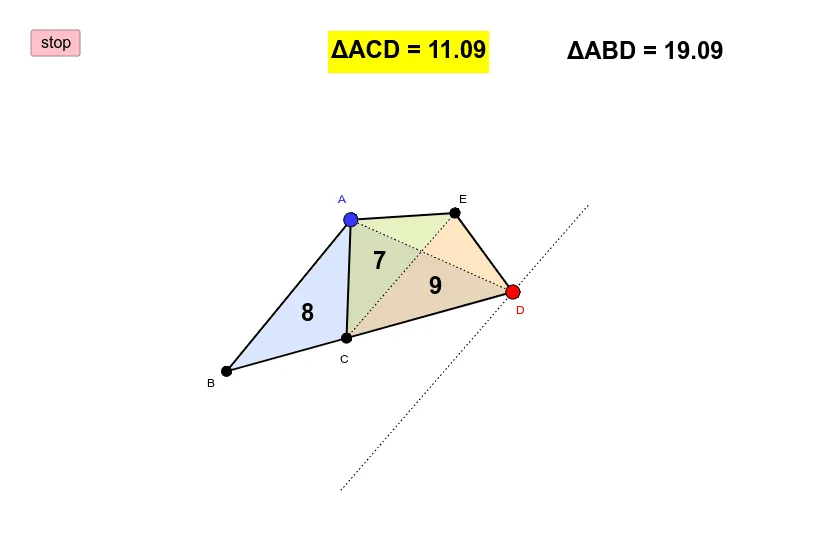
This GeoGebra applet demonstrates the calculation and exploration of triangle areas in plane geometry. By constructing points, segments, lines, and polygons (such as triangles ABC, CDE, ACD, and ABD), it visually illustrates how to use geometric properties and tools like orthogonal vectors to analyze and find the area of triangle ABD. The model is helpful for understanding similar triangles, area ratios, and the intrinsic relationships between geometric figures.
Students can interactively manipulate the positions of points within the construction, observing in real time how changes in vertex locations affect side lengths, angles, and ultimately the computed area of triangle ABD. The applet guides learners through multiple solution strategies: applying the standard base-height formula, decomposing composite figures into simpler components, and employing vector methods such as cross products or dot products with orthogonal projections. A key pedagogical focus is the relationship between the areas of triangles that share common bases or altitudes, reinforcing the principle that triangles with equal bases and equal heights have equal areas.
Through dynamic visualization, learners discover that the area of triangle ABD can be determined not only by direct computation but also by comparing it to adjacent triangles such as ACD and ABC, revealing proportional relationships that persist under transformation. The inclusion of orthogonal vectors introduces students to an analytic-geometry perspective, bridging classical synthetic reasoning with coordinate-based problem solving. This dual approach strengthens conceptual understanding and equips students with versatile tools for tackling area problems in both theoretical and applied contexts.
The interactive nature of the applet encourages exploration and hypothesis testing. Students are invited to conjecture how area ratios remain invariant under certain transformations, then verify their hypotheses by dragging vertices and watching the numerical values update instantaneously. This experiential learning process fosters deeper engagement with geometric reasoning and helps build intuition that extends beyond rote formula memorization. The applet is particularly suited for middle school and high school geometry courses, serving as a visual supplement to classroom instruction on triangle area formulas, similarity, and vector applications in geometry.
Loading the math board and drawing, please wait…