
Calculating and Explaining Cuboid Volume with V = a·b·c
Loading the math board and drawing, please wait…
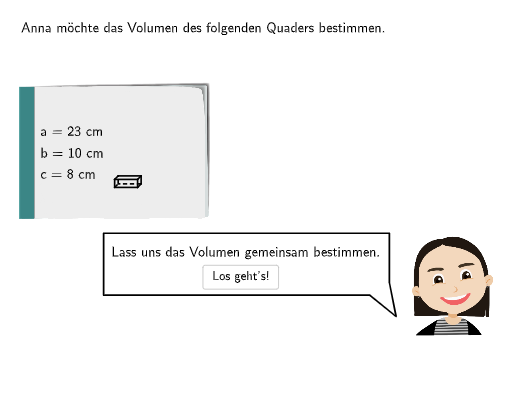
This GeoGebra example uses cuboid and cube scenarios to demonstrate how to compute volume via V = a·b·c, and it includes open questions that ask learners to explain why a particular calculation works, identify mistakes, and solve for an unknown edge length. The key math concepts are solid geometry volume, the meaning of volume as counting unit cubes, applying and justifying the cuboid volume formu
GeoGebra Commands & Parameters
Textfield(vol) → InputBox4Shuffle(Sequence[Random[3, 7], i, 1, 100]) → randomNosFork, {4, 5, 4, 4, 3, 4, 3, 7, 3, 6, 7, 6, 5, 7, 6, 4, 4, 4, 5, 7, 4, 4, 7, 5, 5, 3, 4, 3, 4, 7, 6, 3, 3, 6, 5, 5, 4, 3, 6, 6, 6, 4, 4, 3, 3, 4, 6, 7, 5, 3, 7, 3, 4, 7, 4, 3, 6, 5, 6, 6, 3, 7, 6, 5, 5, 7, 5, 6, 5, 7, 5, 3, 7, 5, 4, 4, 4, 4, 6, 5, 5, 3, 6, 7, 3, 4, 3, 7, 3, 3, 4, 7, 4, 5, 4, 3, 4, 7, 3, 6}Element(randomNosFork, Mod[questionCount, 100] + 1) → kShuffle(Sequence[Random[1, 7], i, 1, 100]) → randomNosForB, {7, 1, 6, 2, 2, 1, 1, 2, 3, 6, 3, 6, 3, 5, 7, 5, 1, 4, 4, 3, 1, 3, 7, 1, 7, 2, 7, 1, 4, 5, 5, 1, 5, 4, 2, 7, 6, 1, 6, 6, 7, 6, 6, 4, 4, 3, 6, 7, 6, 1, 6, 2, 3, 6, 5, 7, 5, 4, 5, 2, 2, 6, 7, 1, 7, 4, 6, 3, 4, 4, 5, 3, 6, 5, 4, 4, 3, 2, 5, 2, 6, 6, 7, 6, 3, 4, 3, 5, 1, 1, 3, 4, 1, 4, 5, 7, 6, 3, 5, 3}Shuffle(Sequence[Random[10, 59], i, 1, 100]) → randomNosForA, {20, 23, 51, 21, 23, 43, 13, 40, 31, 14, 28, 52, 40, 41, 39, 45, 41, 51, 23, 46, 56, 12, 10, 28, 25, 37, 12, 27, 57, 50, 25, 11, 17, 52, 59, 43, 17, 20, 33, 44, 43, 35, 34, 25, 45, 49, 21, 24, 50, 34, 57, 37, 48, 32, 56, 11, 42, 20, 14, 35, 37, 53, 43, 19, 47, 49, 35, 14, 53, 15, 31, 46, 56, 34, 43, 23, 38, 55, 21, 55, 47, 40, 58, 31, 58, 28, 15, 30, 23, 48, 31, 23, 30, 26, 13, 36, 29, 59, 21, 18}Element(randomNosForA, Mod[questionCount, 100] + 1) → aShuffle(Sequence[Random[6, 9], i, 1, 100]) → randomNosForC, {7, 8, 6, 8, 7, 7, 6, 9, 9, 9, 8, 6, 8, 8, 8, 6, 9, 6, 8, 8, 8, 7, 9, 6, 6, 7, 6, 8, 7, 9, 9, 8, 8, 6, 6, 6, 6, 9, 9, 6, 8, 8, 7, 8, 8, 7, 6, 6, 6, 9, 6, 7, 9, 7, 7, 6, 7, 8, 8, 9, 9, 8, 7, 6, 9, 8, 8, 6, 9, 9, 6, 7, 7, 9, 7, 6, 9, 9, 7, 7, 7, 7, 7, 9, 6, 7, 9, 6, 6, 7, 8, 7, 8, 8, 8, 9, 6, 6, 9, 9}Element(randomNosForC, Mod[questionCount, 100] + 1) → cMax(groessen) → maxNumShuffle(Sequence[Random[1, 4], i, 1, 100]) → randomNosForEinheit, {1, 2, 2, 2, 1, 4, 1, 3, 3, 4, 2, 3, 4, 4, 1, 2, 2, 2, 4, 1, 1, 1, 2, 4, 3, 1, 2, 3, 4, 4, 4, 4, 2, 3, 1, 2, 2, 2, 4, 2, 2, 2, 2, 1, 3, 1, 2, 4, 3, 1, 4, 2, 3, 3, 1, 3, 4, 1, 4, 3, 3, 3, 3, 4, 1, 2, 1, 4, 2, 1, 1, 1, 4, 3, 4, 1, 2, 1, 2, 3, 4, 4, 2, 3, 1, 1, 3, 2, 1, 1, 3, 1, 1, 2, 1, 3, 3, 1, 2, 3}Element(randomNosForEinheit, Mod[questionCount, 100] + 1) → EinheitIf(maxNum > 20, 0.03, 0.1) → kuerzungRotate(B + (((b * kuerzung) * verzerrung), 0), winkel, B) → CRotate(A + (((b * kuerzung) * verzerrung), 0), winkel, A) → DRotate(F + (((b * kuerzung) * verzerrung), 0), winkel, F) → GRotate(E + (((b * kuerzung) * verzerrung), 0), winkel, E) → HSegment(A, B) → abSegment(B, C) → bcSegment(C, D) → cdSegment(A, E) → aeSegment(B, F) → bfSegment(E, F) → efSegment(E, H) → ehSegment(F, G) → fgSegment(G, H) → ghSegment(A, D) → adSegment(D, H) → dhSegment(C, G) → cgSpeechBubbleRight(Bubble + (0.47, -0.1), 10.7, 1.3) → bubble2Textfield(aInput) → InputBox1Textfield(bInput) → InputBox2Textfield(cInput) → InputBox3SelectedIndex(selectedDrop) → indexSpeechBubbleRight(PBubble4, 4.6, 1.7) → bubble3SpeechBubbleRight(Bubble1, 8, 1.5) → poly1SpeechBubbleRight(PBubble3, 8, 2.5) → poly2