
Calculate the Area of a Circle: Geometric Construction and Formula Application
Loading the math board and drawing, please wait…
In collections
Kreis Umfang und Flächeninhalt
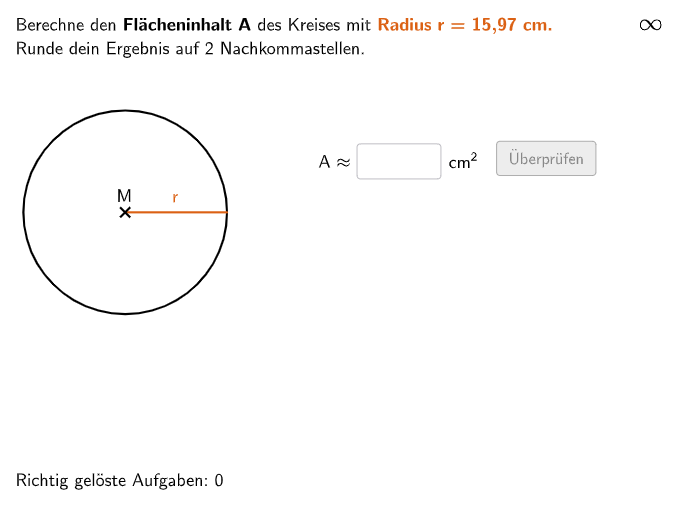
This example demonstrates calculating the area of a circle, especially through geometric construction and formula application to understand the concept of circle area. Key mathematical concepts include the area formula for circles, areas of semicircles, quarters, and eighths. Construction points involve using GeoGebra commands like Circle, Segment, Intersect to construct circles and related figure
GeoGebra Commands & Parameters
Textfield(input1) → InputBox1Textfield(input2) → InputBox2Shuffle(Sequence[Random[1, 20], i, 1, 100]) → randomNosForX, {3, 6, 15, 19, 5, 13, 3, 14, 10, 14, 8, 9, 18, 2, 15, 17, 11, 18, 8, 16, 17, 8, 17, 9, 3, 13, 4, 6, 8, 11, 18, 10, 2, 20, 15, 18, 20, 14, 13, 17, 15, 16, 5, 9, 2, 15, 10, 14, 3, 4, 16, 10, 15, 4, 6, 12, 8, 3, 4, 12, 14, 10, 12, 4, 16, 7, 15, 6, 1, 1, 3, 12, 17, 3, 8, 8, 3, 5, 10, 3, 13, 2, 17, 7, 20, 15, 7, 18, 6, 11, 18, 9, 10, 11, 20, 16, 12, 13, 14, 1}Element(randomNosForX, Mod[questionCount, 100] + 1) → numXShuffle(Sequence[Random[1, 99], i, 1, 100]) → randomNosForY, {40, 18, 97, 84, 73, 29, 77, 5, 88, 68, 93, 98, 18, 21, 88, 25, 6, 49, 43, 32, 29, 41, 65, 95, 58, 44, 91, 22, 95, 70, 53, 72, 42, 59, 25, 28, 47, 38, 98, 16, 93, 61, 95, 30, 61, 6, 92, 98, 38, 11, 30, 76, 99, 76, 21, 73, 47, 35, 40, 88, 65, 93, 16, 43, 51, 45, 99, 41, 89, 79, 96, 87, 85, 83, 90, 87, 32, 29, 67, 36, 90, 85, 8, 26, 48, 45, 48, 68, 53, 24, 49, 48, 68, 67, 7, 47, 95, 8, 18, 45}Element(randomNosForY, Mod[questionCount, 100] + 1) → numYIf(Mod[questionCount, 2] ≟ 0, (num^(2) * pi), (((num) / 2)^(2) * pi)) → umfangPolygon(PtopLeftCornerFeedback, PtopRightCornerFeedback, PbottomRightCornerFeedback, PbottomLeftCornerFeedback) → rectangleCorrect, rectangleCorrectS3, rectangleCorrectS4, rectangleCorrectS2, rectangleCorrectS1Append(true, Sequence[If[randomNosForX(i) ≟ randomNosForX(i - 1), false, true], i, 2, 100]) → stayXAppend(true, Sequence[If[randomNosForY(i) ≟ randomNosForY(i - 1), false, true], i, 2, 100]) → stayYRemove(Sequence[If[stayX(i), randomNosForX(i), 0], i, 1, 100], Sequence[0, i, 1, 100]) → randomNosForXwithoutRepeatRemove(Sequence[If[stayY(i), randomNosForY(i), 0], i, 1, 100], Sequence[0, i, 1, 100]) → randomNosForYwithoutRepeatElement(randomNosForXwithoutRepeat, Mod[questionCount, Length[randomNosForXwithoutRepeat]] + 1) → numXwithoutRepeatElement(randomNosForYwithoutRepeat, Mod[questionCount, Length[randomNosForYwithoutRepeat]] + 1) → numYwithoutRepeatCircle(M, B) → cSegment(M, B) → rRay(B, M) → gIntersect(c, g) → C, DSegment(B, D) → dRemoveUndefined({floor(input1 / 10), Mod[floor(input1), 10], floor(Mod[round((input1 * 100)), 100] / 10), Mod[round((input1 * 100)), 10]}) → listInputRemoveUndefined({floor(sol / 10), Mod[floor(sol), 10], floor(Mod[round((sol * 100)), 100] / 10), Mod[round((sol * 100)), 10]}) → listSolIf(Mod[questionCount, 2] ≟ 0, (((num) / 2)^(2) * pi), (num^(2) * pi)) → umfangVertauschtMod((input1 * 1000), 10) → hintRunden