
Binomial Multiplication Example
Loading the math board and drawing, please wait…
In collections
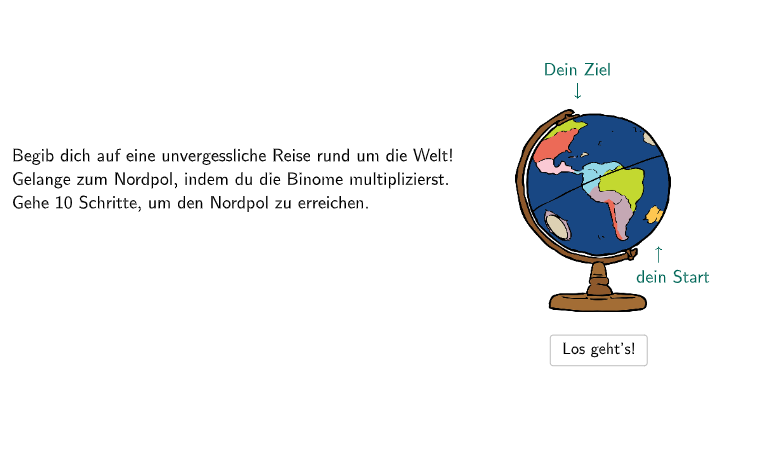
Multiplikation von Binomen
This example demonstrates the geometric interpretation and calculation process of binomial multiplication, involving core math concepts like polynomial multiplication rules, algebraic expression simplification, and geometric transformations. It utilizes GeoGebra commands and objects such as Textfield, Shuffle, Text, TextToUnicode, Polygon, Element, Append, Remove, Corner, Point, Circle, Vector, Co
GeoGebra Commands & Parameters
Textfield(bInput) → InputBox2Shuffle({1, 2, 3, 4, 5, 6, 7, 8, 9}) → ListExNumLeicht, {2, 6, 9, 3, 1, 5, 4, 7, 8}Shuffle({10, 11, 12, 13, 14, 15, 16, 17, 18}) → ListExNumMittel, {10, 14, 17, 13, 18, 11, 15, 16, 12}Shuffle({19, 20, 21, 22, 23, 24, 25, 26, 27}) → ListExNumSchwer, {25, 20, 24, 23, 19, 27, 22, 26, 21}Text(I) → ITextTextToUnicode(IText) → ITextUnicodePolygon(PtopLeftCornerFeedback, PtopRightCornerFeedback, PbottomRightCornerFeedback, PbottomLeftCornerFeedback) → rectangleCorrect, ptopleftcornerfeedback, ptoprightcornerfeedback, pbottomrightcornerfeedback, pbottomleftcornerfeedbackShuffle(Sequence[Random[0, 10], i, 1, 100]) → randomNosForX, {2, 0, 5, 5, 8, 3, 1, 7, 8, 10, 2, 7, 2, 4, 3, 2, 9, 4, 6, 5, 8, 4, 8, 4, 10, 2, 1, 9, 10, 6, 1, 2, 10, 0, 4, 10, 2, 5, 9, 7, 3, 9, 2, 10, 4, 7, 8, 2, 9, 7, 10, 0, 6, 10, 5, 8, 2, 2, 7, 3, 7, 6, 9, 5, 2, 8, 8, 9, 6, 6, 8, 9, 3, 10, 8, 7, 3, 6, 8, 10, 3, 2, 2, 5, 8, 2, 3, 8, 6, 0, 3, 3, 10, 6, 9, 6, 4, 4, 6, 6}Element(randomNosForX, Mod[questionCount, 100] + 1) → numXShuffle(Sequence[Random[0, 10], i, 1, 100]) → randomNosForY, {0, 3, 6, 6, 1, 0, 1, 7, 8, 2, 2, 6, 8, 4, 9, 6, 4, 3, 7, 1, 6, 4, 8, 3, 3, 2, 7, 2, 1, 0, 8, 8, 5, 2, 5, 4, 9, 4, 10, 10, 7, 6, 9, 5, 9, 10, 4, 2, 6, 5, 7, 9, 10, 1, 1, 10, 10, 4, 5, 2, 7, 2, 4, 0, 7, 3, 4, 0, 1, 8, 2, 4, 8, 1, 0, 4, 9, 6, 7, 6, 4, 8, 4, 9, 0, 9, 8, 5, 3, 3, 10, 1, 7, 2, 8, 2, 3, 9, 2, 4}Element(randomNosForY, Mod[questionCount, 100] + 1) → numYAppend(true, Sequence[If[randomNosForY(i) ≟ randomNosForY(i - 1), false, true], i, 2, 100]) → stayYRemove(Sequence[If[stayY(i), randomNosForY(i), 0], i, 1, 100], Sequence[0, i, 1, 100]) → randomNosForYwithoutRepeatElement(randomNosForYwithoutRepeat, Mod[questionCount, Length[randomNosForYwithoutRepeat]] + 1) → numYwithoutRepeatTextfield(cInput) → InputBox3Corner(BildBlue, 1) → controlBlueCorner(BildGelb, 1) → controlGelbCorner(BildRosa, 1) → controlRosaCorner(BildGreen, 1) → controlGreenPoint(line3) → PCircle(P, Q) → circTextfield(inputAdd1) → Eingabefeld1Textfield(inputAdd2) → Eingabefeld2Polygon(PtopLeftCornerFeedback_{1} + (0.95, 0), PtopRightCornerFeedback_{1} + (-0.1, 0), PbottomRightCornerFeedback_{1} + (-0.1, 0), PbottomLeftCornerFeedback_{1} + (0.95, 0)) → rectangleCorrect_{1}, strecke4, strecke1, strecke2, strecke3Polygon(PtopLeftCornerFeedback_{2}, PtopRightCornerFeedback_{2}, PbottomRightCornerFeedback_{2}, PbottomLeftCornerFeedback_{2}) → rectangleCorrect_{2}, ptopleftcornerfeedback_{2}, ptoprightcornerfeedback_{2}, pbottomrightcornerfeedback_{2}, pbottomleftcornerfeedback_{2}Polygon(PtopLeftCornerFeedback_{3}, PtopRightCornerFeedback_{3}, PbottomRightCornerFeedback_{3}, PbottomLeftCornerFeedback_{3}) → rectangleCorrect_{3}, ptopleftcornerfeedback_{3}, ptoprightcornerfeedback_{3}, pbottomrightcornerfeedback_{3}, pbottomleftcornerfeedback_{3}Point(circSpecial) → B_2Point(circ2) → C_2Point(circ2) → D_2Point(circ3) → E_2Point(circ3) → F_2Point(circ4) → G_2Point(circ4) → H_2Point(circ5) → I_2Point(circ5) → J_2Point(circ6) → K_2Point(circ6) → L_2Point(circ7) → M_2Point(circ7) → N_2Point(circ8) → O_2Point(circ8) → P_2Point(circ9) → Q_2Point(circ9) → R_2Point(circ10) → S_2Vector(B_2, C_2) → vec7Vector(D_2, E_2) → vec8Vector(F_2, G_2) → vec9Vector(H_2, I_2) → vec1Vector(J_2, K_2) → vec2Vector(L_2, M_2) → vec3Vector(N_2, O_2) → vec4Vector(P_2, Q_2) → vec5Vector(R_2, S_2) → vec6CountIf(a ≟ true, a, bv) → correctProblemsTextToUnicode(Text15) → BuchstabenAlleUnicodeIntersection(BuchstabenAlleUnicode, ITextUnicode) → BuchstabenInputUnicodeTextToUnicode(ListFunktionSol(exNum)) → SolTextUnicodeIntersection(SolTextUnicode, BuchstabenAlleUnicode) → BuchstabenSolUnicodeDefined(I) → fixedhelperCorner(currentEx, 3) → AnchorBinomMitteCorner(currentEx, 4) → W_2Corner(Text3, 3) → Z_2Line(C_3, xAxis) → fTextfield(I) → InputBox1Distance(AnchorBinom2, AnchorBinom3) → aTextToUnicode(Element[ListeVariablen(1), 1]) → l1If(blue, controlBlue, gelb, controlGelb, rosa, controlRosa, controlGreen) → controlMasterText(Text16, controlMaster + (1.2, -0.1), false, true, -1, 0) → Text17CircumcircleArc(AnchorBinom1 + derring, AnchorBogerl13, AnchorBinom3) → bogerl1CircumcircleArc(AnchorBinom1 + derring, AnchorBogerl14, AnchorBinom4) → bogerl2CircumcircleArc(Mirror[AnchorBinom2 + derring, f], Mirror[AnchorBogerl24, f], Mirror[AnchorBinom4, f]) → bogerl4CircumcircleArc(Mirror[AnchorBinom2 + derring, f], Mirror[AnchorBogerl23, f], Mirror[AnchorBinom3, f]) → bogerl3If(questionCount ≟ 1, circSpecial, questionCount ≟ 6, circ6, questionCount ≟ 7, circ7, questionCount ≟ 8, circ8, questionCount ≟ 9, circ9, questionCount ≟ 10, circ10, questionCount ≟ 2, circ2, questionCount ≟ 3, circ3, questionCount ≟ 4, circ4, questionCount ≟ 5, circ5) → Golasso