
3D Construction and Demonstration of a Cone
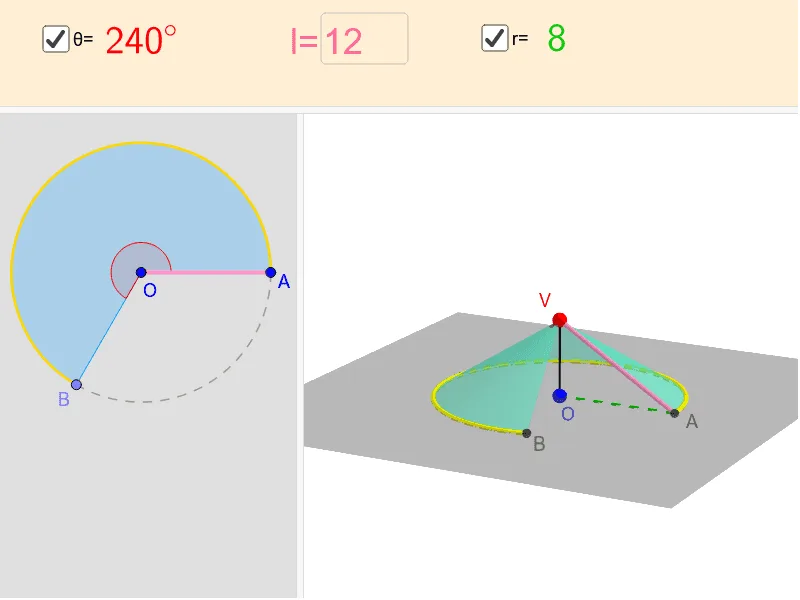
This GeoGebra applet demonstrates the three-dimensional construction and visualization of a cone using geometric commands and surface tools. The activity guides students through the process of building a cone from fundamental geometric elements: a base circle, an apex point, and the cone's height. By defining the circular base in the 3D coordinate plane, placing the apex at a specified distance above the center, and applying GeoGebra's surface and sector commands, the applet generates both the lateral curved surface and the flat circular base of the cone in real time.
The construction begins by drawing the base circle and marking its center, followed by positioning the apex directly above the center along the vertical axis. Students can observe how the height parameter controls the steepness or slant of the cone, while the radius of the base determines its overall width. The lateral surface is formed by connecting every point on the circular base to the apex, creating the characteristic conical shape. Additionally, the applet illustrates the relationship between a circular sector and the unfolded lateral surface of a cone, showing how a sector of a circle can be rolled into the conical surface—a key connection between plane geometry and solid geometry.
Interactive controls allow users to adjust the radius of the base, the height of the cone, and the position of the apex, enabling dynamic exploration of how these parameters affect the cone's dimensions, including the slant height and the central angle of the corresponding net sector. This interactivity supports inquiry-based learning, as students can experiment with different configurations and observe immediate visual feedback.
The applet serves as a powerful teaching aid for solid geometry lessons, helping learners develop spatial reasoning skills by visualizing a cone as a generated surface rather than a static object. It bridges the gap between two-dimensional planar constructions and three-dimensional solids, reinforcing concepts such as cross-sections, nets, slant height, and the relationship between a cone and its circular base. Suitable for secondary school mathematics classrooms, this tool is ideal for introducing cone properties, exploring geometric transformations, and preparing students for topics involving volume and surface area calculations.
In collections
S3 Area and Volume
Loading the math board and drawing, please wait…